

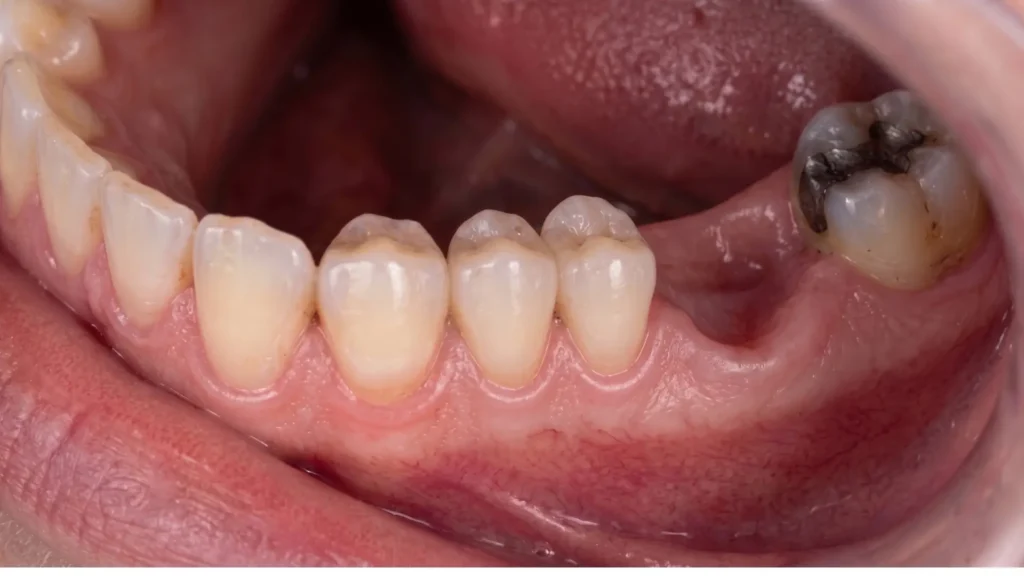
A lost molar is not always visible when you smile, which is why the absence of a back tooth may initially seem like a minor aesthetic concern. In reality, molars play an important role in chewing and in maintaining the proper relationship between teeth on both arches. For this reason, after losing a posterior tooth, a dental consultation is recommended to evaluate the bite, the remaining space, and bone condition.
What happens to the teeth around the space
Following the loss of a molar, adjacent teeth do not remain permanently fixed in place. Over time, shifting and tilting toward the edentulous space can occur, and the opposing tooth in the opposite arch may overerupt vertically because it no longer has normal occlusal contact. Studies on unreplaced posterior spaces confirm the presence of such changes, although their extent varies considerably from person to person.
These shifts can alter the way teeth meet during chewing. Therefore, what begins as a single missing tooth can develop over time into an occlusion problem or contribute to dental anomalies. This does not mean every patient will automatically develop complications, but the risk must be evaluated individually by a dentist.
Why chewing can become less efficient
Molars are anatomically designed for crushing and grinding food. When one is missing, the load during mastication can shift to the remaining teeth. The patient may begin chewing predominantly on the opposite side or avoiding certain areas altogether, altering normal chewing habits.
When multiple posterior teeth are missing, the functional effect can become more pronounced. Furthermore, an altered bite can affect chewing performance; dental literature indicates that certain types of malocclusion are associated with changes in masticatory efficiency.
Front teeth can end up taking on a heavier load
When the posterior region no longer contributes adequately to chewing, the patient may end up relying more on other areas of the dental arch. However, the idea that a single lost molar will inevitably “ruin” the front teeth is an oversimplification. Force distribution depends on the number of missing teeth, their position, the type of bite, and individual habits.
This is precisely why a replacement plan is never decided based solely on appearance. A dental X-ray can provide detailed information about adjacent roots, bone levels, and local anatomical features whenever the examination is indicated.
Can losing a molar change facial structure?
Losing a single molar does not automatically produce noticeable or premature changes in facial appearance. This claim must be evaluated within a clinical context. Facial changes are far more relevant when multiple teeth are missing, soft tissue support is reduced, and substantial bite collapse occurs. Nevertheless, the prolonged absence of a tooth can be accompanied by changes in the alveolar bone in that area, and the extent of these changes varies. Therefore, evaluating the edentulous space early—before tooth alignment and local conditions deteriorate further—is beneficial.
How can a missing molar be replaced?
Depending on the clinical situation, the solution may be a dental implant with a dental crown, a dental prosthesis, or another prosthetic alternative. The choice depends on bone volume, existing teeth, occlusion, general health, and the patient’s goals.
For a dental implant, an initial evaluation determines whether the necessary conditions for dental implant placement are met and whether adjunctive procedures are required. Broadly speaking, the dental implant stages include evaluation and planning, implant placement surgery, and, after the required healing and osseointegration period, delivery of the prosthetic restoration.
In cases requiring bone or soft tissue management, dentoalveolar surgery performed by an oral surgeon may be involved. However, a dental surgical procedure is not necessary for every patient, and indications are determined solely after an examination.
Before choosing a treatment, a dental clinic in Chișinău such as Imperial Dent evaluates the entire clinical picture, not just the missing tooth. The goal is to ensure the selected solution helps restore function and maintain long-term oral health through dental services tailored to each individual case.