

It is one of the most common reasons for concern at the dental clinic: a tooth that, in theory, no longer has a nerve, but suddenly starts hurting, sometimes even more intensely than before treatment. For many patients, this situation seems contradictory – “how can something that no longer has feeling hurt?” The explanation lies in the tooth structure and the complexity of dental infections that can remain hidden for years.
Tooth structure and the role of the dental pulp
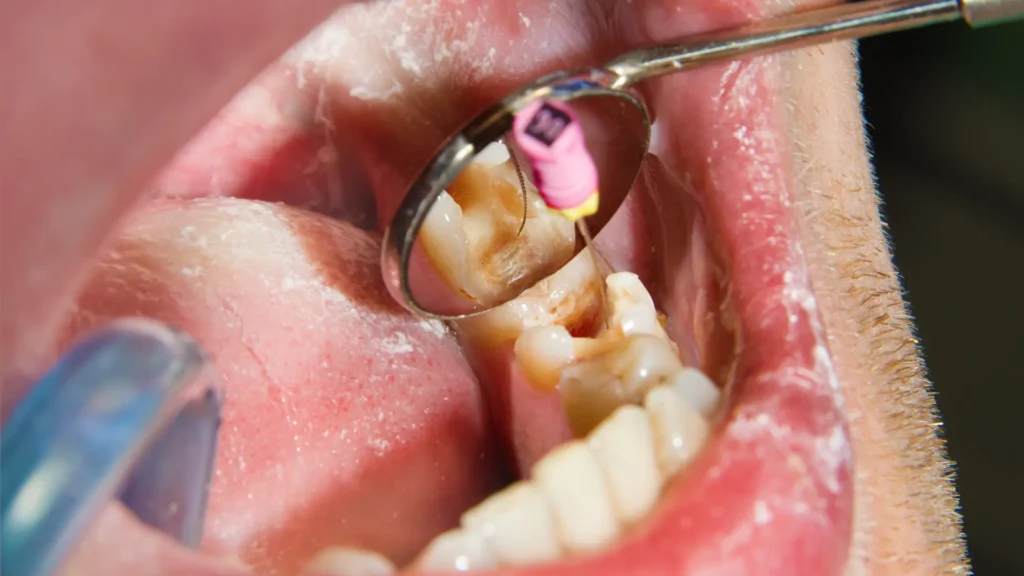
To understand why pain occurs, it helps to understand tooth anatomy. Beneath the enamel and dentin lies the dental pulp, the tissue containing the dental nerves and blood vessels. When this pulp is irreversibly compromised – usually due to an untreated deep cavity – endodontic treatment (root canal treatment) is performed, through which the nerve is removed and the root canals are cleaned and filled.
However, the absence of a nerve inside the tooth does not mean a complete absence of sensation around it. The structures surrounding the root – the periodontal ligament, alveolar bone, and adjacent tissues – remain fully innervated. That is why even a tooth that is pulpal-wise “dead” can generate pain if an infection develops at the root level.
Where hidden infections come from
Cleaning root canals is a high-precision procedure, yet root canals frequently present complex anatomy: fine branches, pronounced curvatures, or accessory canals difficult to detect with the naked eye. If bacteria remained in these inaccessible areas during previous endodontic treatment, they can stay dormant for years without symptoms until the immune system weakens or a trigger occurs.
The result is frequently the formation of a dental cyst or periapical lesion at the root tip, visible on a dental X-ray as a well-defined, round radiolucent area. The cyst represents the body’s defense reaction to chronic infection, but left untreated, it can expand, affecting the surrounding bone and, in advanced cases, jeopardizing adjacent teeth.
Symptoms that should not be ignored
Signs that may indicate a hidden infection in an endodontically treated tooth include:
-
pain when chewing or upon gentle tapping (percussion) on the tooth
-
persistent sensitivity to heat, even though the tooth has no nerve
-
localized swelling on the gum, sometimes accompanied by a fistula
-
an unpleasant taste, signaling drainage of infection
-
recurrent discomfort, with periods of calm followed by flare-ups
Any combination of these signs warrants a dental consultation as soon as possible to evaluate the condition before the infection advances further.
The role of 3D tomography and the microscope in saving the tooth
Technological advances in recent years have radically transformed the prognosis of these cases. A conventional, two-dimensional dental X-ray can miss small infections or hidden root canals. Dental cone beam computed tomography (CBCT) provides detailed three-dimensional images, allowing the endodontist to precisely locate the dental cyst, identify previously undetected canals, and plan treatment with millimeter accuracy.
Alongside 3D imaging, microscopic endodontic treatment represents an essential step in complex retreatments. The surgical operating microscope offers magnified visualization of the canals, enabling the detection of micro-fractures, separated instrument fragments, or residual infection areas—details impossible to observe with conventional equipment. This level of precision significantly increases the chances of completely eliminating the infection and saving the tooth, avoiding an extraction that might otherwise seem inevitable.
Retreatment or extraction? How the decision is made
Not every case can be saved through endodontic retreatment. The decision depends on several factors: the size of the dental cyst, the amount of remaining sound tooth structure, the presence of root fractures, and the overall condition of the surrounding bone. At a dental clinic in Chișinău equipped with 3D technology, the dentist can provide an accurate diagnosis and transparently discuss treatment options: microscopic root canal retreatment, apical surgery, or, in irreversible situations, tooth extraction followed by a dental bridge or dental implant.
Prevention remains the best strategy
Many of these complications can be prevented through prompt and proper tooth decay treatment, restoring teeth using minimally invasive techniques, and scheduling regular preventive checkups. Furthermore, periodontal treatment and careful monitoring of previously treated endodontic teeth significantly lower the risk of late-onset oral infections.
How to resolve the problem?
The solution? Turn to a trusted dental clinic with a skilled medical team and modern technical equipment. The rest rests with the specialists.